
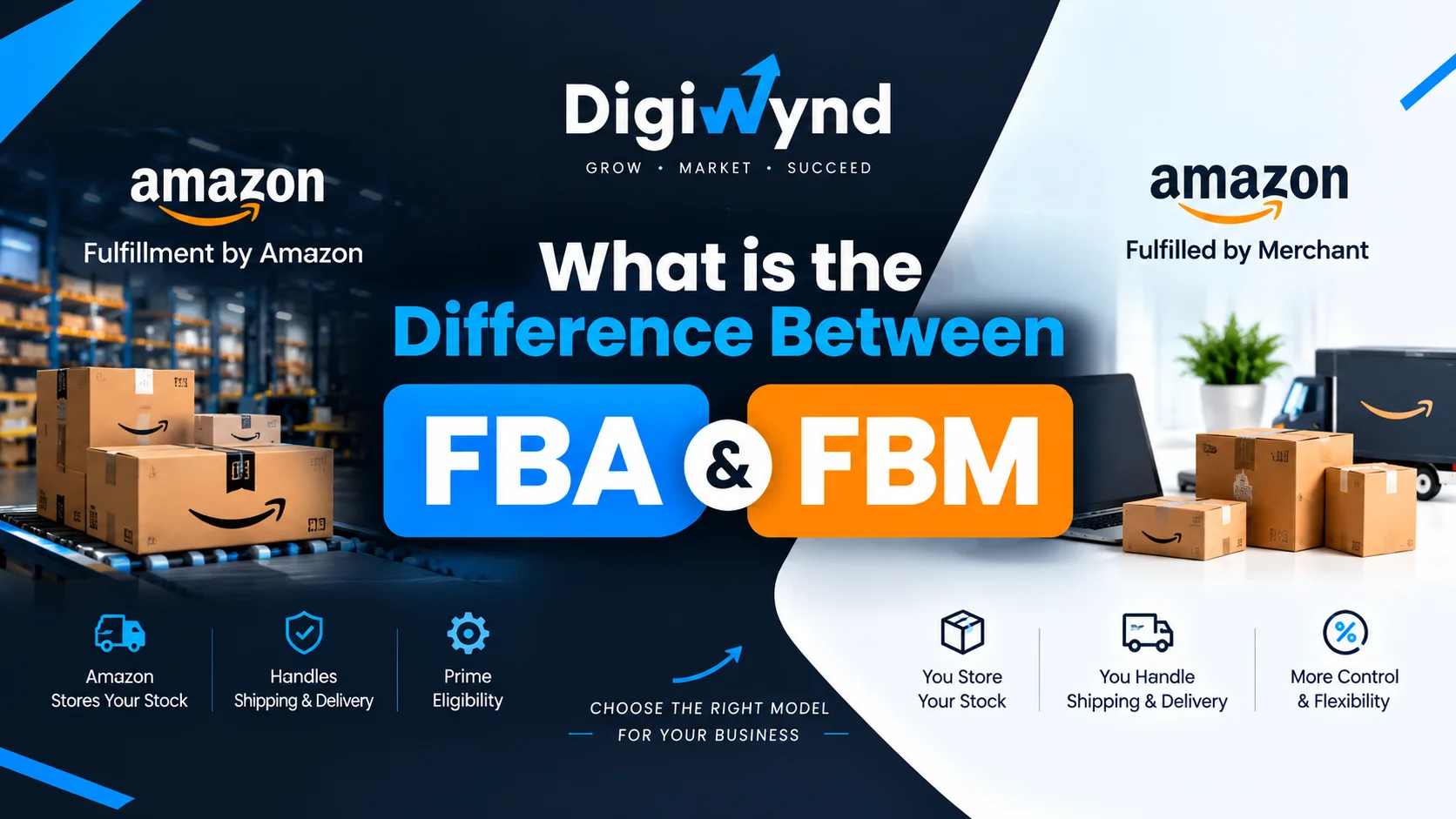
This guide explains the difference between Amazon FBA and FBM, compares their fees and operational requirements, and gives you a practical framework for choosing the right fulfillment method for each product.
What Is Amazon FBA?
Fulfillment by Amazon is a service that lets sellers send eligible inventory to Amazon fulfillment centers. When a customer orders, Amazon picks, packs, and ships the product. Amazon also handles fulfillment-related customer service and eligible returns.
FBA can make an offer eligible for Prime delivery when program requirements are met. The seller still owns the inventory and remains responsible for product sourcing, listing quality, pricing, advertising, compliance, forecasting, and profitability.
What Is Amazon FBM?
Fulfilled by Merchant means the seller lists products in the Amazon store but stores and ships inventory independently. Fulfillment may happen from the seller's home, warehouse, retail location, or through a third-party logistics provider.
With FBM, the merchant controls picking, packing, carriers, delivery standards, customer communication, and returns. Amazon provides tools such as Buy Shipping, but sellers must meet Amazon's shipping and customer-service performance requirements.
FBA vs. FBM: The Main Difference
The central difference is responsibility. FBA outsources most physical fulfillment to Amazon, while FBM keeps fulfillment under the seller's control. That single decision affects cost structure, Prime eligibility, workload, inventory location, packaging control, and scalability.
Factor | Amazon FBA | Amazon FBM |
Inventory storage | Amazon fulfillment centers | Seller or 3PL |
Picking and packing | Amazon | Seller or partner |
Shipping | Amazon fulfillment network | Seller-selected carriers |
Customer service | Amazon handles fulfillment support | Merchant manages support |
Returns | Amazon processes eligible returns | Merchant manages returns |
Prime | Eligible offers can receive Prime benefits | Possible only through qualifying programs |
Control | Less direct control | Greater operational control |
Cost model | Fulfillment and storage fees | Warehouse, labor, packing, and postage costs |
How Amazon FBA Works
• Create or match an accurate product listing.
• Confirm that the product is eligible for FBA.
• Prepare and label units according to current requirements.
• Create a shipment and send inventory to the assigned location.
• Amazon receives and stores the units.
• Amazon fulfills customer orders and handles related support.
• You monitor stock, fees, returns, advertising, and replenishment.
FBA reduces daily shipping work, but it requires disciplined inventory planning. Slow-moving stock can tie up cash and create storage or aged-inventory charges.
How Amazon FBM Works
• List the product and select merchant fulfillment.
• Store saleable inventory in your own facility or with a 3PL.
• Set realistic handling times and shipping templates.
• Receive order notifications and pick the correct item.
• Pack the order safely, purchase shipping, and confirm dispatch.
• Upload valid tracking and deliver within the promised window.
• Manage customer questions, returns, refunds, and performance metrics.
FBM gives greater control, but operational mistakes can hurt the customer experience and seller-account health.
Amazon FBA Fees vs. FBM Costs
Typical FBA costs
• Selling-plan and referral fees
• Per-unit fulfillment fees based on product attributes
• Monthly inventory storage
• Possible aged-inventory, removal, disposal, preparation, return, or placement charges
• Inbound freight to Amazon
Typical FBM costs
• Selling-plan and referral fees
• Warehouse or storage expense
• Labor for picking, packing, support, and returns
• Boxes, labels, protective materials, and equipment
• Carrier postage, insurance, and delivery adjustments
• Software or 3PL fees
FBM is not automatically cheaper because its costs are distributed across operations. Compare the full cost per delivered order, not only Amazon's visible fees. Amazon's Revenue Calculator can help compare estimated FBA costs with your own fulfillment method.
Advantages of Amazon FBA
• Convenience: Amazon handles storage, order fulfillment, and related customer service.
• Prime delivery: Eligible offers can benefit from fast Prime shipping.
• Scalability: Order volume can grow without hiring a packing team for every increase.
• Operational consistency: Amazon manages much of the delivery workflow.
• Time savings: Sellers can focus on sourcing, listings, ads, and brand growth.
Disadvantages of Amazon FBA
• Fulfillment, storage, and additional service fees can reduce margin.
• Slow inventory may generate extra costs and restrict cash flow.
• Sellers have less control over packaging and the delivery experience.
• Receiving or reconciliation issues may require investigation.
• FBA does not create demand; weak products can still fail.
Advantages of Amazon FBM
• Control: Choose packaging, carriers, workflows, and storage conditions.
• Flexibility: Useful for customized, fragile, temperature-sensitive, or special-handling products.
• Potential savings: Established logistics operations may fulfill certain products efficiently.
• Direct inventory access: Stock remains available for multiple channels or local sales.
• Better fit for some products: Bulky, low-velocity, or seasonal inventory may suit FBM.
Disadvantages of Amazon FBM
• The seller carries the daily workload and staffing responsibility.
• Shipping costs can be high without negotiated rates or efficient zones.
• Late dispatches, invalid tracking, cancellations, or poor service can damage account health.
• Scaling quickly requires space, systems, labor, and carrier capacity.
• Prime eligibility is not automatic for standard merchant-fulfilled offers.
When Is FBA Better?
FBA often fits small, lightweight, consistently selling products with healthy margins and predictable replenishment. It is also attractive when outsourcing fulfillment frees the team to improve listings, launch products, or manage advertising.
Choose FBA only after calculating referral fees, fulfillment charges, storage, inbound shipping, advertising, expected returns, landed cost, and taxes. A high sales price does not guarantee a healthy contribution margin.
When Is FBM Better?
FBM can be better for oversized or heavy products, slow-moving inventory, custom-made goods, products requiring special packaging, and sellers with efficient warehouse operations. It may also serve as a backup during FBA stockouts or capacity limits.
FBM works best when you can meet delivery promises consistently and know your true labor, packaging, postage, return, and overhead costs.
Can You Use FBA and FBM Together?
Yes. Amazon's official guidance states that sellers can use one method for all eligible products or combine both. A hybrid strategy is often the most practical choice.
You might use FBA for fast-moving standard products, FBM for oversized or customized items, and both methods for a high-value listing to create backup inventory. Each SKU should be evaluated on demand, dimensions, margin, seasonality, and operational capacity.
How to Choose Between FBA and FBM
• Calculate unit economics: Compare every fulfillment expense under realistic sales and return assumptions.
• Assess demand: Fast turnover favors FBA; uncertain velocity can favor controlled FBM stock.
• Measure size and weight: Product dimensions strongly affect storage and shipping.
• Evaluate your operation: Include labor, space, systems, accuracy, and customer-support capacity.
• Consider conversion: Estimate whether Prime benefits may improve sales enough to justify FBA costs.
• Review product needs: Fragile, customized, or regulated items may need specialized handling.
• Test both methods: Begin with a controlled quantity and compare profit, speed, returns, and workload.
FBA vs. FBM Profit Formula
For FBA, estimate: selling price minus referral fee, FBA fulfillment fee, storage allocation, inbound freight, landed cost, advertising, returns, and other expenses.
For FBM, estimate: selling price minus referral fee, landed cost, storage, labor, packaging, postage, software or 3PL fees, advertising, returns, and overhead.
Use conservative assumptions and review actual costs monthly. Revenue is not profit, and the lower advertised fee is not always the lower total cost.
Common FBA and FBM Mistakes
• Choosing one method for the entire catalog without SKU-level analysis
• Ignoring returns, damaged units, labor, or aged inventory
• Comparing Amazon fees with postage alone instead of total fulfillment cost
• Overstocking FBA before validating demand
• Setting unrealistic FBM handling or delivery times
• Failing to maintain accurate tracking and inventory counts
• Assuming Prime eligibility automatically guarantees profitability
• Never testing a hybrid strategy
Frequently Asked Questions
Is FBA or FBM better for beginners?
FBA is easier operationally, while FBM offers more control. The better option depends on the product, available capital, margin, space, and ability to fulfill orders accurately.
Is Amazon FBM free?
No. FBM sellers still pay applicable Amazon selling and referral fees, plus their own storage, labor, packaging, shipping, software, and return costs.
Does FBA always win the Buy Box?
No fulfillment method guarantees the Featured Offer. Price, inventory availability, delivery performance, customer service, and other factors can influence eligibility and selection.
Can I switch from FBM to FBA?
Yes, for eligible products. Review current preparation and shipment requirements, create an FBA offer, and send inventory through Seller Central.
Can the same product have FBA and FBM offers?
FBA is easier operationally, while FBM offers more control. The better option depends on the product, available capital, margin, space, and ability to fulfill orders accurately.
Is Amazon FBM free?
No. FBM sellers still pay applicable Amazon selling and referral fees, plus their own storage, labor, packaging, shipping, software, and return costs.
Does FBA always win the Buy Box?
No fulfillment method guarantees the Featured Offer. Price, inventory availability, delivery performance, customer service, and other factors can influence eligibility and selection.
Can I switch from FBM to FBA?
Yes, for eligible products. Review current preparation and shipment requirements, create an FBA offer, and send inventory through Seller Central.
Can the same product have FBA and FBM offers?
No fulfillment method guarantees the Featured Offer. Price, inventory availability, delivery performance, customer service, and other factors can influence eligibility and selection.
Can I switch from FBM to FBA?
Yes, for eligible products. Review current preparation and shipment requirements, create an FBA offer, and send inventory through Seller Central.
Can the same product have FBA and FBM offers?
Many sellers use both methods as part of a hybrid strategy, subject to listing, inventory, and program requirements.
Final Verdict: FBA, FBM, or Both?
FBA is strongest when convenience, Prime delivery, and scalability outweigh its fees. FBM is strongest when control, specialized handling, or an efficient fulfillment operation produces better economics. For many businesses, the best answer is both.
Use current Amazon fee information and the Revenue Calculator, test with limited inventory, and make the decision product by product. The right fulfillment method is the one that protects customer experience while producing sustainable profit.