
Why Category Selection Matters More Than a Product List
A profitable private-label business begins with the economics and behavior of a category, not with a list of fashionable products. Categories determine typical selling prices, referral fees, fulfillment costs, return rates, compliance requirements, advertising intensity, seasonality, and how strongly established brands control demand. The same product idea can be attractive in one subcategory and impossible in another. A $50,000 budget provides meaningful room for inventory, branding, content, and launch advertising, but it is still finite. The objective is therefore not to find the biggest market. It is to find an addressable niche where the budget can buy enough inventory, learning, and customer acquisition to reach a stable operating position.
Define What “Under $50,000” Really Means
Treat $50,000 as total launch capital, not as an inventory allowance. The budget may need to cover research tools, samples, design, trademarks, product testing, manufacturing deposits, final payments, inspections, freight, duties, marketplace preparation, photography, listing content, advertising, promotions, returns, storage, and a reorder reserve. If the first purchase order consumes nearly all the cash, the business may run out of money precisely when the product begins to gain traction. Decide in advance how much capital can be lost without damaging personal or company finances. Then work backward to a product and category whose minimum viable launch fits inside that risk limit.
Step 1: Set Your Investment Criteria
Create written criteria before opening a product-research tool. Define the target selling-price range, maximum landed cost, desired contribution margin, acceptable product size and weight, maximum lead time, compliance tolerance, seasonality limits, and the amount reserved for advertising. Also define what you will avoid, such as fragile products, batteries, ingestibles, products for infants, strong patent activity, hazardous materials, or categories dominated by a few famous brands. These rules prevent emotional decisions. They also make opportunities comparable because every category is judged with the same scorecard rather than by excitement, estimated revenue, or a supplier’s persuasive quotation.
Step 2: Measure Stable Customer Demand
Demand should be proven by several signals. Review marketplace search-volume trends, bestseller movement, keyword seasonality, competitor sales consistency, review velocity, and how many independent keywords lead to the same customer need. A category built around one viral phrase is riskier than one supported by several stable search paths. Compare at least twelve months of data when possible and note holiday peaks separately. Amazon’s Product Opportunity Explorer can help sellers study niches, search behavior, pricing, reviews, and unmet customer needs using marketplace data. Use demand estimates as ranges rather than exact predictions, and test whether the opportunity still works at the low end of the range.
Step 3: Study Competition at the Search-Result Level
Category-level revenue can hide brutal competition. Search the most important buyer phrases and examine the first page for review counts, ratings, brand concentration, listing quality, price clustering, sponsored density, coupons, delivery promises, and product differentiation. If most clicks flow to household names with thousands of reviews, a new private label may need more capital than expected. Look for reachable gaps: inconsistent quality, outdated images, weak instructions, poor sizing options, missing bundles, frequent complaints, or audiences that current products overlook. Competition is acceptable when you can explain exactly why a qualified customer will choose your offer and how you will communicate that difference.
Step 4: Read Reviews as Product-Development Research
Reviews are a free product-development database. Collect recent positive, negative, and neutral reviews across several leading products. Group repeated comments into themes such as durability, materials, dimensions, comfort, packaging, assembly, odor, instructions, missing accessories, or customer service. Separate complaints caused by unrealistic expectations from problems a supplier can actually solve. A strong private-label opportunity appears when an important complaint is common, technically fixable, and visible enough to support marketing. The goal is not to create a product with every feature. It is to improve the few attributes that matter most to the buyer while keeping cost and complexity controlled.
Step 5: Calculate True Unit Economics
Use a complete profit model for every category candidate. Include unit manufacturing cost, packaging, quality inspection, international freight, duties, inbound transportation, prep, marketplace referral fees, fulfillment fees, storage, expected returns, discounts, advertising, and a defect allowance. Amazon notes that referral fees vary by category, while fulfillment costs are strongly influenced by dimensions and weight. Estimate contribution profit at realistic prices rather than the highest competitor price. Calculate the break-even advertising cost of sales and model a price reduction. Reject products that only work under perfect conversion, unusually cheap advertising, or optimistic freight assumptions.
Step 6: Evaluate Size, Weight, and Fulfillment Risk
Physical characteristics can determine whether a category is profitable. Large, heavy, fragile, liquid, magnetic, temperature-sensitive, or oddly shaped products can increase freight, storage, damage, preparation, and return costs. Small changes in packaging dimensions may move an item into a more expensive fulfillment tier. Ask suppliers for packaged dimensions and weight, not only product measurements, and verify them on samples. Compare FBA, merchant fulfillment, and third-party logistics where relevant. A compact product is not automatically good, but operational simplicity gives a new brand more room to survive forecasting errors and advertising volatility.
Step 7: Check Restrictions, Safety, and Compliance
Some attractive categories require approval, laboratory testing, safety documentation, labeling, certifications, insurance, or special handling. Beauty, supplements, children’s products, electronics, medical-related products, food-contact items, and products making performance claims deserve careful review. Check Amazon selling policies and applicable laws before placing an order. Verify patents, trademarks, design rights, and restricted keywords. Obtain documents from qualified sources rather than accepting a supplier’s verbal assurance. Compliance is part of product cost and lead time. A category is not profitable if inventory can be suspended, recalled, rejected at customs, or prevented from being advertised.
Step 8: Test Supplier Feasibility
A promising category must also be manufacturable at the required quality, cost, and quantity. Send a clear specification to several suppliers and compare minimum order quantities, customization, tooling, lead times, payment terms, packaging capability, test reports, communication, and willingness to correct defects. Order samples from the best candidates and use a scorecard to test performance. Ask what changes will affect price or production time. Build in an independent pre-shipment inspection for the first meaningful order. If only one supplier can produce the design or the minimum order consumes most of the budget, supplier concentration becomes a major risk.
Step 9: Estimate Advertising Difficulty
A category can show excellent product margins but become unprofitable when customer acquisition is included. Review suggested bids, sponsored density, competitor advertising, keyword concentration, and how many relevant long-tail terms exist. If almost all demand is concentrated in a few expensive keywords, the launch may require sustained spending before organic visibility develops. Model conversion at conservative rates and calculate the number of clicks required to produce an order. Advertising should be treated as both acquisition and research, but the business must be able to afford the learning period. A healthy category offers several ways to reach buyers rather than one auction that controls the market.
Step 10: Assess Return Rate and Customer-Service Burden
Returns reduce profit through refunds, damaged inventory, processing costs, and lost advertising. Categories involving fit, sizing, subjective color, complex assembly, compatibility, fragile parts, or performance expectations often carry higher return risk. Read reviews to identify the main reasons customers send products back. Decide whether better design, instructions, images, a compatibility chart, or protective packaging can reduce those reasons. Also estimate support questions and warranty exposure. A product that earns a strong gross margin but produces constant returns and complaints may consume more cash and management time than a lower-margin product with predictable customer behavior.
Step 11: Look for Repeatability and Product-Line Potential
A private-label brand is stronger when the first product can lead naturally to related products, refills, accessories, bundles, sizes, or premium versions. Evaluate whether the category serves a clear audience whose next problems you can solve. Product-line potential improves the value of customer knowledge and creative assets, but avoid using future possibilities to justify weak first-product economics. The initial offer must succeed on its own. Favor categories where brand trust matters and where improvements can be protected through design, sourcing, content, or community—not categories in which every seller offers an identical item and competes only on price.
A Practical $50,000 Budget Allocation
A balanced planning model might reserve approximately $18,000 to $22,000 for initial inventory and packaging, $4,000 to $6,000 for freight, duties, inspection, and preparation, $3,000 to $5,000 for samples, design, photography, trademark, and compliance, $7,000 to $10,000 for launch advertising and promotions, and $10,000 to $15,000 as working capital and reorder protection. These are planning ranges, not universal targets. A regulated or tooling-heavy product needs more development capital, while a simple compact product may require less logistics spending. Never force a product into the model; adjust the allocation using real quotations and conservative sales assumptions.
Category Profiles Worth Investigating
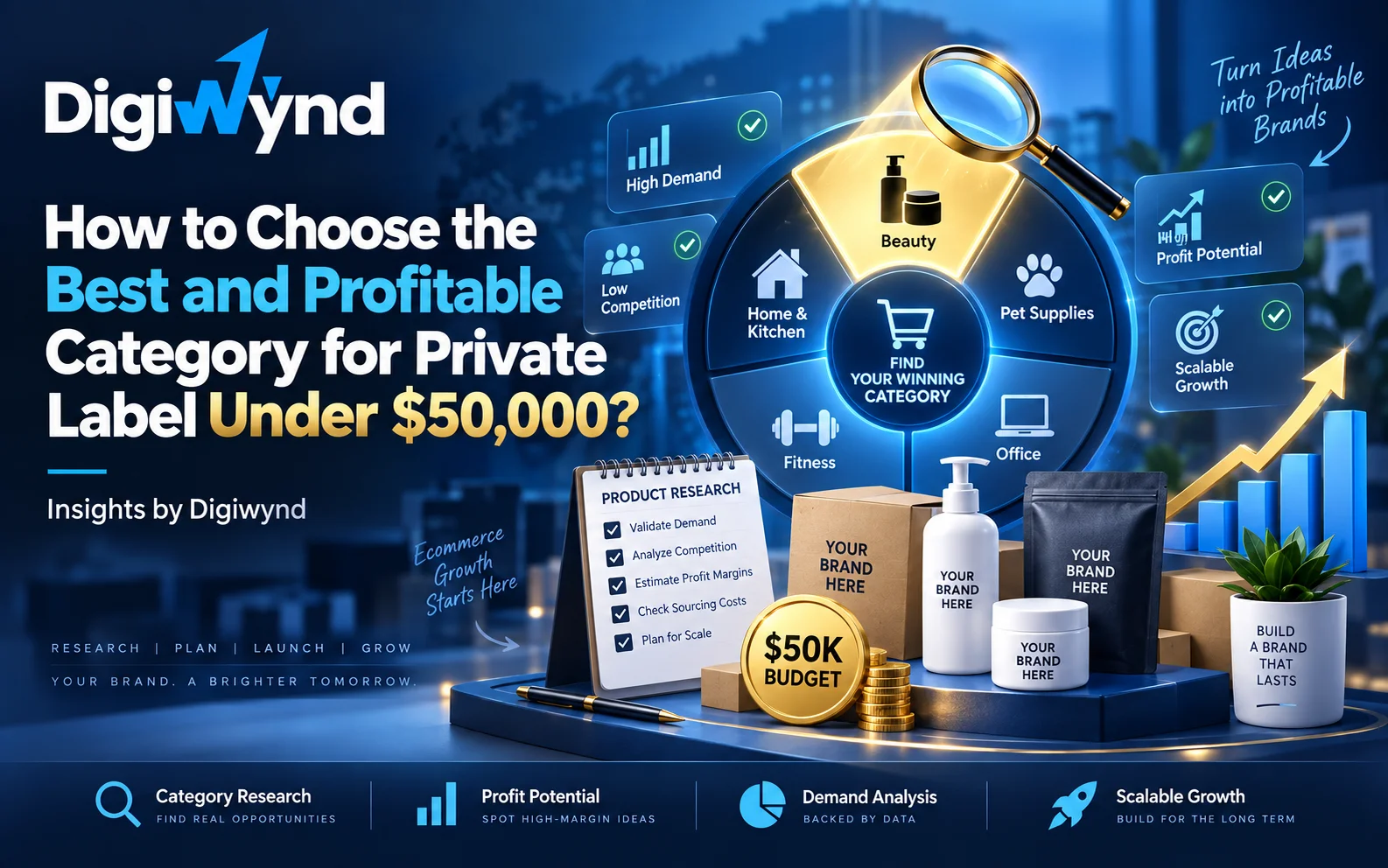
Home and kitchen can offer broad demand and visible improvement opportunities, but competition and design patents require care. Pet supplies can support passionate audiences and repeat purchases, though safety and durability matter. Office and organization products may have stable demand, yet commodity competition is common. Fitness and outdoor accessories can create strong use-case branding but may be seasonal or liability-sensitive. Beauty accessories may support attractive presentation and margins, while cosmetic formulas create greater compliance risk. These are research starting points, not recommendations. The profitable opportunity is usually a focused subcategory with a solvable problem, not the category name itself.
Categories That Often Need Extra Caution
Supplements, medical claims, products for babies, batteries, complex electronics, topical cosmetics, food, hazardous materials, oversized furniture, and highly fragile goods can demand more compliance, testing, insurance, expertise, or working capital. Popular licensed characters and obvious copies create intellectual-property risk. Trend products can collapse before the second shipment arrives. Low-priced commodities leave little room for advertising and fulfillment. None of these categories is automatically impossible, but a first-time seller with a $50,000 ceiling should understand why the added complexity produces a defensible advantage. If complexity only increases risk, choose a simpler path.
Build a Weighted Category Scorecard
Turn research into a decision by scoring each candidate from one to five across demand stability, competition accessibility, contribution margin, advertising difficulty, supplier reliability, compliance burden, return risk, seasonality, differentiation potential, and product-line expansion. Weight margin, demand, compliance, and cash requirements more heavily than personal preference. Record the evidence behind every score and flag assumptions that still need validation. Compare three to five finalists, then perform deeper research on the top two. A scorecard does not remove uncertainty; it exposes where optimism is influencing the decision and creates a record that can be reviewed before capital is committed.
Run a Downside Stress Test
Before approving a category, reduce the expected selling price, increase landed cost and advertising bids, slow the sales forecast, raise the return rate, and extend the supplier lead time. Then recalculate cash flow and reorder timing. Ask what happens if inventory arrives late, a competitor launches a coupon, freight increases, or the listing converts below plan. Determine the maximum safe purchase order and the point at which you would stop investing. A resilient category does not need every assumption to be correct. The downside case may be unattractive, but it should be survivable without exhausting the entire $50,000.
Validate With Small Commitments
Move from inexpensive evidence to expensive evidence. Start with keyword and review research, then obtain quotations, order several samples, test the product, verify documents, and conduct small customer tests where permitted. Improve the specification before committing to a large production run. Negotiate a manageable minimum order quantity, but do not sacrifice quality merely to reduce units. Use each step as a decision gate: continue only if the new evidence supports demand, differentiation, compliance, and margin. This staged approach preserves capital and prevents enthusiasm from turning a weak category into an oversized inventory problem.
Common Category-Selection Mistakes
The most common mistake is choosing a category because its total revenue looks impressive. Other errors include relying on a single research tool, ignoring seasonality, using gross margin instead of contribution margin, underestimating PPC, trusting unverified supplier certifications, overlooking return patterns, and spending the full budget on inventory. Sellers also confuse low-quality competitors with low competition; sometimes weak listings exist because the economics are unattractive. Avoid copying arbitrary rules such as a fixed review count or search volume without context. Build a decision from multiple signals and reject opportunities that depend on fragile assumptions.
Frequently Asked Questions
Is $50,000 enough for an Amazon private-label launch? It can be enough for a carefully selected product, but the required capital depends on minimum order quantity, compliance, freight, advertising, and reorder timing. Which category is most profitable? There is no permanently best category; profitability exists at the product and niche level after fees, competition, returns, and acquisition costs. Should beginners avoid competitive categories? Not necessarily, but they need a clear differentiation and a budget capable of earning visibility. How many products should be launched? One well-validated product is usually safer than dividing the budget across several unproven launches. Should all $50,000 be spent? No. Retain working capital for advertising, unexpected costs, and reorders.
Final Decision Checklist
Before choosing the category, confirm that demand is stable, important keywords are reachable, the customer problem is real, differentiation is visible, the selling price supports all costs, compliance is understood, suppliers can meet the specification, returns are manageable, and the first order leaves enough capital for launch and reorder. The category should still be viable under a conservative downside scenario. Most importantly, you should be able to explain in one sentence why a specific customer will choose the brand. If that answer is unclear, more research is needed before the budget is committed.
Final Thoughts
The best private-label category under $50,000 is not the one with the highest estimated sales. It is the category where customer demand, reachable competition, healthy contribution margin, operational simplicity, meaningful differentiation, and cash-flow requirements fit together. Use data to create a shortlist, customer feedback to design the offer, supplier evidence to validate feasibility, and a downside model to protect capital. A disciplined category decision will not eliminate risk, but it gives the brand enough runway to learn, improve, reorder, and grow.